|
For Windy Hill Press |
 |











Steinbeck Country Links & ArticlesPlaces to Visit with Steinbeck Associations Steinbeck Country Visitor Resources Steinbeck Biographical and Literary Resources A Tour of John Steinbeck’s “Valley of the World” - article
Places to Visit with Steinbeck Associations Carmel - Point Lobos State Reserve enjoyed by John and his sisters and site of memorial service Carmel - Mission San Carlos Borromeo de Carmelo visited in The Pastures of Heaven Carmel - Robinson Jeffers’s Tor House, a favorite poet of John and his mother Fremont Peak State Park – where the writer and Charley bade farewell to Steinbeck Country Jolon - Mission San Antonio de Padua, setting for To A God Unknown Monterey - Cannery Row on-Line guide heritage pages Monterey – Photo tour of Steinbeck related sites Pacific Grove- A self-guided driving tour of Steinbeck’s Pacific Grove Pacific Grove - Museum of Natural History displays of plants, animals, and geology, including a squid donated by Ed Ricketts. Salinas - Steinbeck’s family grave site in The Garden of Memories Salinas - National Steinbeck Center museum celebrating the writer’s life and works Salinas - The Steinbeck House and Restaurant. The Steinbeck family home San Jose- Center for Steinbeck Studies at San Jose State University – archive and visitor center Soledad - Mission Nuestra Señora de la Soledad, isolated mission near the setting for Of Mice and Men Stanford University, Department of Special Collections – holds important Steinbeck and Ricketts papers Weedpatch (nr. Bakersfield) – Arvin Farm Labor Camp featured in The Grapes of Wrath
Steinbeck Country Visitor ResourcesBig Sur Chamber of Commerce - resource guide to lodging, camping, restaurants, gift shops, art galleries and things to do in Big Sur Central Coast Tourism Council – lodgings and attractions of the coastal counties from Santa Cruz to Ventura Monterey – Agricultural and winery tours of Salinas Valley and Monterey Peninsula offered by AG Venture Tours Monterey County Convention & Visitors Bureau - events, attractions and travel information for the area Monterey County Vintners & Growers – describes the wineries, vineyards, climates, and appellations of the Salinas and Carmel Valleys. Pacific Grove Chamber of Commerce – recreation and travel information on the town where Steinbeck learned his craft. Pacific Grove - Museum of Natural History. Permanent exhibits of plants animals, geology, and marine life. Includes a squid specimen donated by Ed Ricketts. Pelican Network – web site describing the natural and cultural resources of Steinbeck Country Salinas Valley – "The Farm" - Demonstration farm, agricultural tours, and produce stand Salinas Valley Chamber of Commerce – visitor information on the town and valley known as “The Salad Bowl of the World.” Steinbeck Country Wineries -
Steinbeck Biographical and Literary Resources
Martha Heasley Cox Center for Steinbeck Studies, San Jose State University – pages on the writer’s life and work The New Steinbeck Society of America (NSSA) - promotes scholarly and popular interest in John Steinbeck The California Novels – chapter summary and list of main characters of the novels Perspectives in American Literature - A Research and Reference Guide Monterey County Historical Society – includes a chronology and a list of books Pat Hathaway Collection of Historical Photos of Steinbeck, Ricketts and the region Stanford University, Department of Special Collections – description of Steinbeck and Ricketts’s papers in the archives The Nobel Prize in Literature 1962 – includes a short biography and text of the acceptance speech Used and rare books by and about John Steinbeck www.waywardbooksonline.com New books by and about John Steinbeck Steinbeck Books - National Steinbeck Center
A Tour of John Steinbeck’s David A. Laws Based on “A Virtual Tour of Steinbeck Country” presented at the John Steinbeck’s Americas Centennial Conference, Hofstra University, March 2002 and reprinted in the Steinbeck Yearbook 2003: Steinbeck's Sense of Place. " I think that I would like to write the story of this whole valley, of all the little towns and all the farms and the ranches in the wilder hills. I can see how I would like to do it so that it would be the valley of the world." (Letters 73) In this quotation from a letter written to his friend George Albee in 1933, John Steinbeck shares his idea of using stories and settings from the Salinas Valley as the raw material for his universal themes of ordinary people in harmony and in conflict with nature, society, and themselves. This article describes a journey through the landscape of golden hills, lush cultivated fields, and agricultural and ocean-front communities that are familiar to generations of readers throughout the world as Steinbeck Country. Although much has changed physically and socially over the last 70 years, by using quotations from his best-loved work as a guide today's visitor can still experience the sense of place that inspired John Steinbeck's "valley of the world." "The Salinas Valley is in Northern California. It is a long narrow swale With these opening words of East of Eden, Steinbeck introduces his readers to the nearly one hundred mile-long agricultural valley that opens onto a broad coastal plain fronting Monterey Bay.
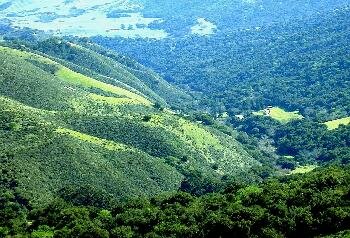
View west across the Salinas Valley from Fremont Peak "I remember that the Gabilan Mountains to the east of the valley were light gay mountains full of sun and loveliness … The Santa Lucias stood up against the sky to the west and kept the valley from the open sea and they were dark and brooding – unfriendly and dangerous." (Eden 3) Both ranges rise steeply from the valley floor to bare grass and chaparral-clothed ridges reaching above 3,000 feet. From an intense green in winter they dry to a burnished golden hue in summer. Steinbeck’s depiction of a light, gay east and a dark and brooding west suggest the extremes of good and evil he chronicled among the communities they shadow. When not shrouded in the chill summer fogs of the California coast, Fremont Peak State Park at the northern end of the Gabilans allows a view of the whole valley and ocean shore. Shown in the photograph above, this is the spot where Charley and his master bade goodbye to Steinbeck Country before returning to the East. "I drove up to Fremont’s Peak, the highest point for many miles around. This solitary stone peak overlooks the whole of my childhood and youth, the great Salinas Valley stretching south for nearly a hundred miles, the town of Salinas where I was born now spreading like crabgrass towards the foothills." (Travels 179) Salinas In Steinbeck's time, and still today, Salinas was the business center for one of the most prosperous agricultural regions in the nation. "Salinas was the county seat and it was a fast growing town. Its population Today the population exceeds 150,000 and sleek automobiles have replaced boxy, black Fords, but it does not take much imagination to see Main Street much as the Steinbeck family knew it, as a bustling district of banks, hotels, and retail stores. In East of Eden Adam Trask…. "turned off Main Street and walked up Central Avenue to number 130, the high white house of Ernest Steinbeck. It was an immaculate and friendly house, surrounded by its clipped lawn, and roses and cotoneastors lapped against its white walls." (Eden 385)
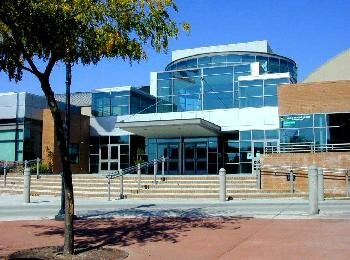
The Steinbeck House, Central Avenue, Salinas Olive and Ernst Steinbeck purchased their Queen Anne-style, redwood frame house in 1900. Their son was born in the room to the left of the entrance in 1902 and lived here with his three sisters until leaving for Stanford University in 1919. As a teenager, Steinbeck composed stories in his gable-end attic bedroom. Many years later he also worked on The Red Pony and Tortilla Flat here while caring for his ailing parents. Today the Valley Guild of Salinas operates the Steinbeck House as a luncheon restaurant and boutique to raise money for charity. Many other buildings in Salinas also enjoy Steinbeck associations. He played basketball and attended his senior prom at W. Alisal and Salinas Streets where ... "In the old troop C armory the home Guard drilled, men over fifty … snapped orders at one another and wrangled eternally about who should be officers." (Eden 516) Around the corner at 242 Main, where in real life Mr. Bell felt it necessary to keep a sharp eye on a sweet-toothed young Steinbeck, Cal and Abra .. "…went into Bell’s candy store and sat at a table. The rage was celery tonic that year. The year before it had been root-beer ice-cream sodas." (Eden 441) The power and wealth of the town was concentrated in imposing bank structures standing on all four corners of Gavilan and Main. In the Greek-porticoed, former Monterey County Bank Kate deposited her money and Cal collected 15 one-thousand dollar bills for his father. These buildings, now restaurants and antique stores, served the landowners and businessmen of the valley, many of whom were angered by the social sympathies expressed in The Grapes of Wrath. By 1973 community anger began to mellow into civic pride with the unveiling of a bronze statue outside the renamed John Steinbeck Library at 350 Lincoln. In 1998, when the National Steinbeck Center opened at the head of Main Street, all was forgiven. The prodigal son had become the favorite son and his name and face now grace businesses and landmarks throughout Salinas.
National Steinbeck Center, One Main Street, Salinas But there are still areas of town that the Chamber of Commerce does not promote. "Over across the tracks down by Chinatown there's a row of whorehouses." (Eden 213) The Chinese population long ago moved on to a better life and the former gambling parlors and houses of ill repute in the area of Soledad Street that fascinated a young Steinbeck, and later provided material for East of Eden, Cannery Row, and other stories, have been replaced by transient hotels and shelters for a current generation of underprivileged citizens. Spreckels Highway 68 leads southwest out of Salinas towards Monterey. Just before the Salinas River bridge, white concrete silos stand tall in the midst of open green fields. "Claus Spreckles came from Holland and built a Sugar Factory and the flatlands of the valley around Salinas were planted to sugar beets and the Sugar People prospered." (America 5) The silos mark the site of the former Spreckels sugar factory whose demand for beets stimulated an important shift in the agricultural pattern of the valley from dry farming to the irrigation culture that dominates the region today. (Note: Steinbeck uses the “les” ending. The community and the company use “els.”)
Silos of the former Spreckels Sugar Factory, Spreckels "Our father was working at the Spreckles Sugar Factory 5 miles from town." (Eden 153) Ernst Steinbeck found part time employment for his son as a night shift lab chemist in the sugar plant where he heard anecdotes that appeared in Tortilla Flat. Corral de Tierra (The Pastures of Heaven) "In a few minutes he arrived at the top of the ridge, and there he stopped, stricken with wonder at what he saw – a long valley floored with green pasturage on which a herd of deer browsed. Perfect live oaks grew in the meadow of the lovely place, and the hills hugged it jealously against the fog and the wind." (Pastures 2)
Corral de Tierra from Laureles Grade The Spanish corporal’s vision of the Pastures of Heaven can still be enjoyed from Laureles Grade between Highway 68 and Carmel Valley, a few miles west of Spreckles. While the valley floor is now crowded with large houses it retains much of the bucolic charm described by Steinbeck in his first California novel. "At the head of the canyon there stands a tremendous stone castle .. like those strongholds the Crusaders put up. Only a close visit to the castle shows it to be a strange accident of time and water and erosion working on soft, stratified sandstone." (Pastures 171) Looking east across the golf course from Corral de Tierra Road, the ramparts of a mediaeval castle appear to crown a distant bluff. Named Castle Rock by British explorer George Vancouver, the Camelot-like towers and turrets fascinated a young Steinbeck who had been captivated by the tales of King Arthur and the Knights of the Round Table since he was nine years old. Even though the illusion evaporated when Steinbeck and his sister Beth rode their horses up close to investigate, his fascination with the setting remained. It forms the backdrop for several stories, including The Murder from The Long Valley. Monterey "Monterey sits on the slope of a hill, with a blue bay below it and with a forest of tall dark pine trees at the back." (Tortilla 2)
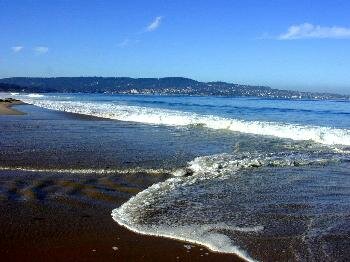
Monterey Peninsula from the Seaside shoreline Monterey fronts the ocean where the Santa Lucia Mountains slope into the sea. The Spanish capital of California, Monterey has evolved from a fishing port to today’s tourist Mecca. Tourism was important even in 1879 when Robert Louis Stevenson arrived in pursuit of his future wife Fanny Van de Grift Osbourne. A childhood meeting between Stevenson and Steinbeck’s neighbor Edith Wagner inspired How Edith McGillcuddy Met RLS. "Monterey is a city with a long and brilliant literary tradition. It remembers with pleasure and some glory that Robert Louis Stevenson lived there." (Cannery 71) In Tortilla Flat Steinbeck paints his most colorful picture of Monterey. Danny and his gang of paisanos lived in pine-shaded canyons on the outskirts of town. Their revels, recalling the exploits of King Arthur's knights set in a world of idyllic poverty, appealed to readers looking for escape from the realities of the Depression and in 1935 gave Steinbeck his first popular success. Cannery Row "Cannery Row in Monterey in California is a poem, a stink, a grating noise, a quality of light, a tone, a habit, a nostalgia, a dream. Cannery Row is the gathered and scattered, tin and iron and rust and splintered wood, chipped pavement, and weedy lots and junk heaps, sardine canneries of corrugated iron, honky tonks, restaurants and whorehouses and little crowded groceries, and laboratories and flophouses." Ocean View Boulevard between Monterey and Pacific Grove hosted the fish canneries that dominated Monterey commerce for 50 years. Epic tales of the lives and loves of the characters who inhabited the area provided the basis for Steinbeck’s Cannery Row. The canning industry collapsed with the disappearance of sardines in the early 1950s and on being renamed after the book business owners began fishing for tourist dollars instead. Hovdens, the last operating cannery, was converted into the popular Monterey Bay Aquarium in 1984 and is perhaps the one gentrification that the writer and his marine biologist friend Ed Ricketts would applaud. "Western Biological .. is a low building facing the street. There is a stairway going up the front of the building and a door that opens into an office where there is a desk piled high with unopened mail." (Cannery 26)
Ricketts's Western Biological Lab, Cannery Row Ricketts, with whom Steinbeck collaborated on Sea of Cortez, was the model for sympathetic characters in a number of the writer’s works. His Pacific Biological Lab, a simple two-story, weather-beaten building at 800 Cannery Row, was the setting for “Doc’s” Western Biological of Cannery Row and Sweet Thursday and the site of legendary parties and deep philosophical discussions. "Lee Chong’s grocery, while not a model of neatness was a miracle of supply. It was small, and crowded but within its single room a man could find everything he needed or wanted to live and be happy – clothes, food, both fresh and canned, liquor, tobacco, fishing equipment, machinery, boats, cordage, caps, pork chops." (Cannery 5) There is little to interest Mac and the Boys today at the Wing Chong Market building across the street, the inspiration for Lee Chong’s Heavenly Flower Grocery. T-shirts and souvenir mugs just don’t deliver the high contained in a quarter pint of “Old Tennis Shoes” whisky. And the strongest brew now offered at Kalisa’s La Ida Café next door is a powerful cup of morning coffee. Pacific Grove "Pacific Grove and Monterey sit side by side on a hill bordering the bay. The two towns touch shoulders but they are not alike." (Thursday 51) Both Steinbeck and Ricketts lived in Pacific Grove on the western tip of the Monterey Peninsula. As Steinbeck notes, while the two towns sit side-by-side, they are polar opposites in character. In contrast to secular, bustling Monterey and it’s Spanish heritage, Pacific Grove started as summer retreat side for devout Methodists and evolved into an upright Victorian residential community. Many of these characteristics lingered into Steinbeck’s time.
The rocky shoreline of Pacific Grove While he poked fun at the town’s traditions, Pacific Grove played an important role in his life. As a child he loved to explore the rocky coastline from a family vacation cottage on 11th Avenue. It was also home to Steinbeck and his first wife Carol from 1930 to 36 as he existed near to poverty learning his craft on the early books, including The Pastures of Heaven, To A God Unknown, Tortilla Flat, and The Red Pony. "Probably nothing in the way of promotion Holman's Department Store ever did attracted so much favorable comment as the engagement of the flag-pole skater." (Cannery 117) The four story bulk of Holman’s, today an antique emporium, towers over retail stores and restaurants along Lighthouse Avenue. Steinbeck purchased ink and many of his friends and characters also conducted business there. A stained glass window over the entrance features the Monarch butterflies satirized in Sweet Thursday. The flagpole skater’s platform was directly overhead. "The Great Tide Pool on the tip of the Peninsula ... is a fabulous place: when the tide is in, a wave-churned basin, creamy with foam, whipped by the combers that roll in from the whistling buoy on the reef. But when the tide goes out the little water world becomes quiet and lovely." (Cannery 30) The rocky headland protecting the Great Tide Pool below Point Pinos Lighthouse was a place of sanctuary for Suzy and other characters from Cannery Row and Sweet Thursday. Here both Doc and Ed Ricketts collected specimens for their marine biology businesses. A squid donated by Ricketts is still on display in the Pacific Grove Natural History Museum. Carmel and Carmel Valley "And Carmel, begun by starveling writers and unwanted painters, is now a community of the well-to-do and the retired. If Carmel’s founders should return, they could not afford to live there, but it wouldn’t go that far. They would be instantly picked up as suspicious characters and deported over the city line." (Travels 178) During his days in Pacific Grove, Steinbeck occasionally drove over the hill to visit friends in Carmel, including journalist Lincoln Steffens whose wife Ella Winter introduced him to labor activists who inspired In Dubious Battle. Here he also met George West, of the San Francisco News, who later commissioned him to write the newspaper articles that led to The Grapes of Wrath. Although Robinson Jeffers was a favorite poet of both Steinbeck and his mother and lived just a short distance from Steffens’s cottage they did not meet until many years later.
The Carmel River, Carmel Valley "The Carmel is a lovely little river. It isn’t very long but in its course it has every thing a river should have. It rises in the mountains, and tumbles down a while, runs through shallows, is dammed to make a lake, spills over the dam, crackles among round boulders, wanders lazily under sycamores, spills into pools where trout live, drops against banks where crayfish live. In the winter it becomes a torrent, a mean little fierce river, and in the summer it is a place for children to wade in and for fishermen to wander in. … It’s everything a river should be." (Cannery 74) Bucolic Carmel Valley and River invaded by Mack and the boys in Lee Chong’s Model-T Ford truck to hunt for frogs in Cannery Row was already beginning to develop into today’s manicured golf and country club resort community at the time of Steinbeck’s visit in Rocinante in 1960. "I went to Carmel Valley where once we could shoot a thirty-thirty in any direction. Now you couldn’t shoot a marble knuckles down without hitting a foreigner." (Travels 176) The flood plain and hillside slopes of Garland Ranch Park preserve a section of the valley and a former livestock ranch in a state that might be recognizable to the famous frog hunters. Drivers who enjoy steep, winding back roads take the 30-mile serpentine route on County Highway G16 over the Sierra de Salinas and through Arroyo Seco Canyon, which opens into the Salinas Valley near Greenfield. A less challenging route follows Highway G20 over Laureles Grade, past the viewpoint for the Pastures of Heaven, and skirts the western foothills along River Road. Salinas Valley "The floor of the Salinas Valley, between the ranges and below the foothills is level because this valley used to be the bottom of a hundred-mile inlet from the sea." (Eden 4)
The Salinas Valley and Santa Lucia foothills from River Road Deep rich soil, year-round irrigation water from the Salinas River, and a temperate climate make the Salinas Valley an extraordinarily productive agricultural region. Promoted as “The Salad Bowl of the World,” it grows most of the nation’s lettuce together with numerous other varieties of produce. Wine grapes, one the first European crops cultivated by the Spanish mission fathers, support an important premium wine business. Generations of immigrants have provided the labor force to work the fields. Hispanic workers succeeded the earlier Chinese, Japanese, Filipinos, and the Okies portrayed in The Grapes of Wrath. Evidence of their culture abounds throughout the valley from colorful street murals to mercados stocked with Mexican produce. With his portrayal of Pepe in Flight, and later Mexican stories, Steinbeck was one of the first American writers to portray sympathetic Hispanic characters. "A few miles south of Soledad, the Salinas River drops in close to the hillside bank and runs deep and clean. The water is warm too because it has slipped twinkling over the yellow sands in the sunlight before reaching the narrow pool." (Mice 3) Steinbeck worked the fields and slept in Spreckels company bunkhouses alongside the Salinas River near Soledad during college breaks. Here he met characters and learned of incidents that inspired Of Mice and Men. Carl Tifflin’s Red Pony ranch description borrows features from his grandfather’s Hamilton Ranch in the foothills near King City, while many stories from The Long Valley are set on the valley floor. San Antonio Valley"Two flanks of the coast range held the valley of Nuestra Senora close on one side guarding it against the sea, and on the other against the blasting winds of the great Salinas Valley." (Unknown 4)South of King City the stewardship of the US Army at Fort Hunter Liggett has preserved the open oak savannah of San Antonio Valley in a state of suspended animation. This landscape, as described in To A God Unknown, remains little changed since Joseph Wayne arrived to claim his homestead. Steinbeck explored the area while recuperating from pneumonia at a ranch near Jolon. "At the far southern end a pass opened in the hills to let out the river, and near this pass lay the church and the little town of Our Lady. .. the church was often vacant now and its saints were worn." (Unknown 4)
Mission San Antonio de Padua, Jolon The adobe walls and tiled roof of Mission San Antonio de Padua at Jolon have been rebuilt since Joseph’s time in one of the most historically unchanged settings in the California mission chain. Much of the funding for the restoration was provided by newspaper magnate W. R. Hearst who commissioned architect Julia Morgan to design a Mission Revival-style ranch house overlooking the mission. Hearst sold the ranch to the army in 1941 and The Hacienda became a hotel for army brass. Today it is open to the public. Big SurNacimento-Fergusson Road winds 24 miles west from Jolon over razorback ridges of the Santa Lucias to the coast at Big Sur. Joseph Wayne traversed this rugged wilderness on his way to meeting “the last man in the western world to see the sun” on the cliffs above Lucia. Steinbeck was familiar with the steep canyons, thick brush and rattlesnakes of this country from his 1920 summer job of surveying for the construction of Highway One. He used this experience to craft his description of the forbidding terrain where Pepe flees from his pursuers in Flight. "About fifteen miles below Monterey, on the wild coast, the Torres family had their farm, a few sloping acres above a cliff that that dropped down to hissing white waters of the ocean. Behind the farm the stone mountains stood up against the sky." (Valley 41)
Big Sur south of Partington Point Point Lobos State Reserve is the last of the wild ocean vistas along the Big Sur coast before Highway One reaches Carmel. Here, on family outings with his sisters, Steinbeck loved to explore the rocky promontory that inspired Robert Louis Stevenson’s Treasure Island. After his death in 1968, his family held a memorial service overlooking Whaler’s Cove before burying his ashes in the Salinas Garden of Memories. Respecting his wishes, Elaine Steinbeck interred her husband’s ashes beside his parents in the Hamilton Family plot. "No man should be buried in alien soil." (Adventures 1037) His grandparents Samuel and Elizabeth Hamilton and their children, all featured in East of Eden, rest nearby. Many of the writer’s detractors are buried here also, but while they have long been silent, Steinbeck’s voice lives on. Steinbeck Works cited Photographs from Steinbeck Country: Exploring the Settings for the Stories |

 Exploring the Settings for the Stories